OKF-KB Design Choices
okf-schema provides an opinionated instantiation of OKF as a knowledge base (through okfkb,
an alias for okf-schema kb).
This article explains the philosophy, design choices, and trade-offs behind the structure.
Core vision: A ready-to-use KB framework optimized for agent-driven experimental findings traceability at scale in HW debugging, scientific projects, and complex engineering teams.
For step-by-step guidance on using okfkb, see:
Setup OKF-KB — Quick reference and command reference
HW Debugging Workflow Tutorial — Real-world automotive debugging example
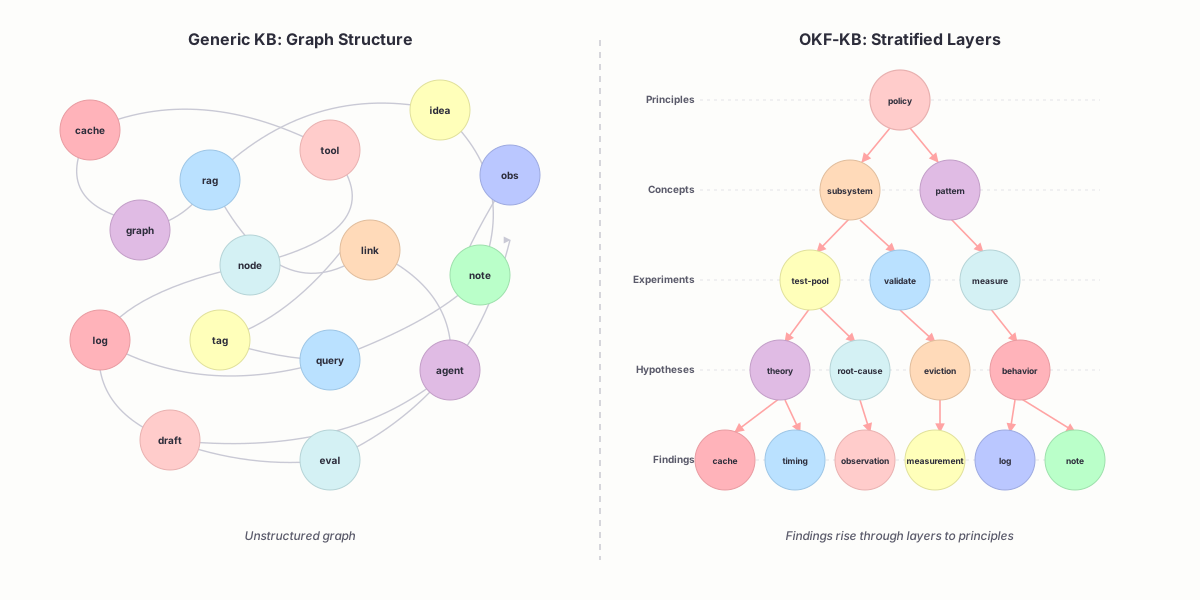
OKF-KB organizes the elements in stratified layers, with findings at the bottom rising through validation to principles at the top.
What is a Knowledge Base?
A knowledge base is a structured, interlinked collection of markdown files containing observations, hypotheses, validated concepts, and principles. Its purpose is to serve as an external memory for coding agents when they engage with a problem domain.
Unlike a flat repository of findings or a wiki, a KB must:
Encode confidence levels — distinguish raw observations from validated concepts
Support contradictions — allow conflicting findings to coexist without requiring immediate resolution
Enable navigation by tier — agents must quickly find the right level of abstraction
Preserve immutability — historical records should not be rewritten
Front-load metadata — agents decide whether to read deep based on frontmatter alone
okfkb addresses all five by design.
Knowledge Lifecycle
In okfkb, every document has a tier that reflects its maturity and confidence level:
Tier |
Purpose |
When to Write |
Confidence |
|---|---|---|---|
findings/ |
Raw observations from debugging/experimentation |
Agent detects anomaly, records via |
Falsifiable |
hypotheses/ |
Testable propositions derived from findings |
Propose explanation for contradiction |
Medium |
experiments/ |
Planned investigations to test hypotheses |
Design test; record expected outcome |
Intended |
concepts/ |
Stable understanding promoted from findings |
Multiple findings converge; confidence High |
High |
structures/ |
Cross-cutting system patterns spanning multiple concepts |
Architect describes subsystem |
High |
principles/ |
Durable, team-agreed standards and “directions” |
Human decision; replaces ad-hoc convention |
Policy |
outcomes/ |
Planned projects or deliverables to build from knowledge |
Track what you’ll build from KB |
Commitment |
reference/ |
External sources: papers, links, third-party docs |
Archive findings backed by citations |
External |
guides/ |
Operational how-to notes (orthogonal to other tiers) |
Record repeatable processes |
Procedural |
The key insight: each tier answers a different question an agent might ask — “What did we observe?”, “What’s stable enough to rely on?”, “What’s still open?”, “What must we build?”

Findings: Agent-Driven Discovery
Findings are the foundational tier. They are created by agents, not humans.
They are immutable and timestamped. They are the raw observations that agents record during debugging or experimentation.
Findings should be understood as the local truth as this specific time with the available data. They are not “corrected” retroactively; instead, new findings may contradict older ones, and the KB preserves the historical record.
Agent Workflow
When an agent (GitHub Copilot, Cursor, Claude Code) detects an anomaly or completes an investigation, it will record a new finding:
# 1. Create a new finding (timestamps and paths auto-generated)
okfkb new-finding "Cache eviction ratio exceeds threshold"

# 2. Agent edits the finding markdown and frontmatter
# (agent sets confidence, links to related docs, adds context)

# 3. Lint and update links/backlinks
okfkb update
Why Agents Create Findings
Humans debugging a complex HW platform can find several mistakes and discover several observations per session.
At the end of each session, agents record findings of this investigation.
The KB grows with:
Exact timestamps (when was this observation made?)
Full context (how was the system configured when this happened?)
Confidence levels (how sure is the agent about this observation?)
Immediate links (what other findings or concepts does this relate to?)
This transforms the KB into a living experimental log, not a summative document.
Findings are Immutable and Falsifiable
Once created, a finding’s body should never be edited.
Instead:
If contradicted by a newer finding, the older finding gets a
status: contradictedfrontmatter field and a pointer to the contradicting finding incontradicted_by: [findings/2026.07.05-...md]The historical record remains intact for audit and reproducibility
Agents can then ask: “What’s the evolution of our understanding of this cache behavior?”
This principle mirrors scientific lab notebooks: observations are historical records, not living documents that get “corrected” retroactively.
Dated Filenames: Chronological Signal
Findings use the naming pattern YYYY.MM.DD-HH.MM-<slug>.md:
findings/2026.07.04-14.30-cache-eviction-anomaly.md
findings/2026.07.03-09.15-boot-sequence-timing-issue.md
findings/2026.07.03-08.45-ddr-initialization-hang.md
Two reasons:
Chronological sort order —
ls findings/shows observations in recording order; agents scan recent findings first without reading file content.Immutability signal — a dated filename signals “this body is historical”. If a human or agent later decides to edit a finding’s body (which shouldn’t happen), the dated filename is an instant red flag that something’s wrong.
Promotion: From Findings to Concepts
Over time, patterns emerge. When multiple findings converge on the same understanding, it’s time to promote that understanding to a Concept.
Example: Cache Eviction
Day 1–3: Raw Findings
findings/2026.07.01-10.30-cache-hit-rate-drops.md
  → confidence: low
  → context: 400 RPS, eviction_ratio 0.75

findings/2026.07.02-14.15-eviction-ratio-exceeds-0.9.md
  → confidence: medium
  → context: 600 RPS, eviction_ratio 0.94
  → links: [findings/2026.07.01-10.30-cache-hit-rate-drops.md]

findings/2026.07.03-09.00-root-cause-identified.md
  → confidence: high
  → context: LRU eviction policy + insufficient memory pool at 700+ RPS
  → links: [findings/2026.07.02-14.15-eviction-ratio-exceeds-0.9.md]
Day 4: Promotion to Concept
concepts/cache-eviction-under-load.md
  ---
  type: Concept
  title: Cache LRU Eviction Becomes Aggressive Above 700 RPS
  confidence: high
  status: active
  promoted_from: [findings/2026.07.01-10.30-cache-hit-rate-drops.md, ...]
  links: [structures/cache-subsystem.md, principles/cache-tuning-policy.md]
  ---

  # Concept: Cache LRU Eviction Under Load

  When system load exceeds 700 RPS, the cache's LRU eviction policy
  becomes too aggressive due to insufficient memory allocation...
Promotion Matters
Without this “compilation” step, agents re-read the same findings repeatedly, unable to distinguish stable knowledge from open questions.
With promotion to higher tier, agents can navigate into the KB, understanding naturally what is still being investigated vs. what is stable enough to rely on.
Trade-offs: Why This Design Over Alternatives?
Alternative 1: Flat Repository of Findings
Pros: Simple, no folder structure overhead Cons:
Agents can’t distinguish raw observations from validated understanding
No canonical path for promotion (finding → concept)
Search becomes expensive; agent must read every file to find relevant context
Confidence signals buried in prose, not frontmatter
okfkb: Tiers enable agents to target the right level of abstraction immediately.
Alternative 3: Spreadsheet or Database
Pros: Queryable; structured fields Cons:
Not suitable for prose + context (findings need narrative)
Not version-controllable (can’t audit changes)
Markup for code/formulas awkward
Agents have poor native support for querying databases
okfkb: Markdown + YAML frontmatter is agent-native; git-friendly; and prose context is preserved. They are also auditable and diffable.
Frontmatter-First: Optimizing for Agent Consumption
Coding agents (GitHub Copilot, Cursor, Claude Code) load files into context windows in chunks. When a file is large, agents typically read the first 20–50 lines and decide whether to read further. This means the beginning of every file is prime real estate.
okfkb exploits this by placing structured metadata at the very top:
---
type: Finding
title: Cache eviction too aggressive
confidence: medium
context: >-
  Observed under 800 RPS load; eviction_ratio hit 0.94.
timestamp: 2026-07-04T14:30:00Z
tags: [cache, performance]
links: [findings/2026.07.03-09.00-root-cause-identified.md]
backlinks: [structures/cache-subsystem.md]
status: active
---

# Finding: Cache eviction too aggressive
...
An agent loading this file sees — before reading a single word of prose — the document’s type, confidence, context, timestamp, and how it relates to other documents. This is vastly better than burying metadata in headings or relying on filename conventions.
log.md: Temporal Entry Point
log.md is a chronological running log of KB changes and decisions:
## 2026-07-04

### New Findings
- `findings/2026.07.04-14.30-cache-eviction-anomaly.md`
  Agent recorded aggressive LRU eviction at 800 RPS.

### Promotions
- `concepts/cache-eviction-under-load.md` promoted from 3 converged findings.

### Decisions
- Team decided to tune LRU pool size (see `principles/cache-tuning-policy.md`).
Agents reading a new KB start with log.md to understand what changed recently
before diving into individual documents. This mirrors how developers use CHANGELOG.md
or git commit history, but optimized for prose context.
Full Agent Reading Path
When an agent is given access to an okfkb, the typical traversal is:
log.md                    ← What changed recently?
  ↓
index.md                  ← What tiers exist? Overview?
  ↓
findings/                 ← Raw observations (most recent first)
  2026.07.04-*.md
  2026.07.03-*.md
  ↓ (via links/backlinks)
hypotheses/               ← Testable ideas derived from findings
  ↓
experiments/              ← Planned investigations
  ↓
concepts/                 ← Stable, promoted understanding
  (cache-subsystem.md) ← which links to...
  ↓
structures/               ← System-level patterns
  ↓
principles/               ← Team standards & policies
  ↓
outcomes/                 ← Projects to build
At each step, links and backlinks guide navigation. The agent builds a mental graph
from frontmatter alone, then dives into prose where needed.
Why a Fixed Folder Structure?
The tier folders (findings/, concepts/, principles/, etc.) are opinionated
because the folder name IS the tier.
Without structure, agents must infer the maturity of each document from prose or custom tags.
With structure, agents know instantly: findings/ = raw obs, concepts/ = stable knowledge.
This enables fast filtering: “Show me only stable concepts” vs. “Show me what we’re still investigating” without parsing a single document body.
Summary: Why This Design?
okfkb’s design choices converge on a single goal: enable agents to build understanding from a KB as efficiently as a human would.
Tiers answer different questions (observations vs. stable knowledge)
Frontmatter-first lets agents decide depth in 20 lines
Immutable findings preserve experimental truth; contradictions coexist
Agent-driven creation ensures findings are fresh and contextualized
Automatic backlinks prevent link rot and enable graph navigation
Dated filenames signal historical record integrity
log.md provides temporal context on demand
Trade-offs: more structure upfront, but dramatically lower KB maintenance burden and much higher agent productivity at scale.